Jiuzhaigou Ultimate Guide: Unveiling the Veil of China’s Most Dreamlike Fairyland

As a traveler who has explored China for fifteen years, I have walked through the wilderness of Tibet, crossed the rice terraces of Yunnan, and climbed the steep peaks of Huangshan. But whenever someone asks me: “What is the one natural wonder in China that you absolutely cannot miss?” My answer is always: Jiuzhaigou.
I completely understand your first reaction when you see the photos: “How can this water possibly be so blue? It must be over-edited!”
I can solemnly assure you that Jiuzhaigou’s beauty is 100% real. When you stand there in person, you will find that no high-resolution photo can fully capture the purity of those colors and the living, breathing vibrancy of the environment. This guide will answer all your doubts and plan a perfect Jiuzhaigou trip for you.
Chapter 1: The Magic of Colors — Why Is the Lake Water So Unbelievably Blue?
This is perhaps the biggest mystery about Jiuzhaigou. This sapphire-and-turquoise-like color does not come from chemical dyes or visual tricks, but is the perfect result of nature’s exquisite physical and chemical processes.
1. Travertine Reflection: Jiuzhaigou’s water flows through strata rich in calcium carbonate (limestone). The calcium carbonate in the water precipitates and deposits, forming pure white travertine layers on the lake bottom and shores. This white base acts like a huge natural reflector. When sunlight hits the lake bottom, it preferentially reflects the shorter wavelengths of blue and green light, thereby intensifying the blue-green tones of the lake water.
2. Water Purity and Selective Scattering: Jiuzhaigou’s water sources come from high-mountain snowmelt and forest-percolated springs — extremely clear, with almost no suspended particles. This ultra-high purity water itself has a “selective scattering” effect on light — water molecules tend to scatter blue and green light more, similar to why we see the sky as blue.
3. Lake Depth and Aquatic Plants: A certain water depth provides space for color presentation. At the same time, the distribution of different depths and different kinds of freshwater aquatic plants (such as algae) adds rich layers of green and yellow to this blue palette.
In simple terms: extremely pure water + white lake bottom + specific depth and biology = the unbelievable dreamlike colors in front of your eyes.

Chapter 2: The Golden Moments — Precisely Targeting the Peak Autumn Week
Autumn in Jiuzhaigou is not a fixed date, but a dynamic, weeks-long symphony of colors. To help you hit it precisely, I divide autumn into three clear phases:
Phase 1: Early Autumn Overture (Last Week of September to First Week of October)
- Color performance: The forests begin shifting from uniform emerald green to multicolored. You will see bright yellows, warm oranges, and hints of red starting to dot the hillsides, like a painter just beginning to test colors on his canvas. Color layering is already present, but has not yet reached the most intense, most saturated state.
- Tourist situation: Except for China’s National Day Golden Week (October 1–7) which is an absolute peak, the early part of this phase has relatively few tourists.
- Pros & cons:
- Advantages: Relatively peaceful travel experience; hotels and flights may be cheaper just before or after Golden Week.
- Disadvantages: Autumn colors not yet at their peak; for photographers chasing ultimate color, it may feel slightly regrettable.
- Suitable for: Travelers who want to avoid the biggest crowds and don’t have extremely high demands for “perfect autumn color.”
Phase 2: Mid-Autumn Grand Movement (Second Half of the Second Week of October to the Fourth Week of October)
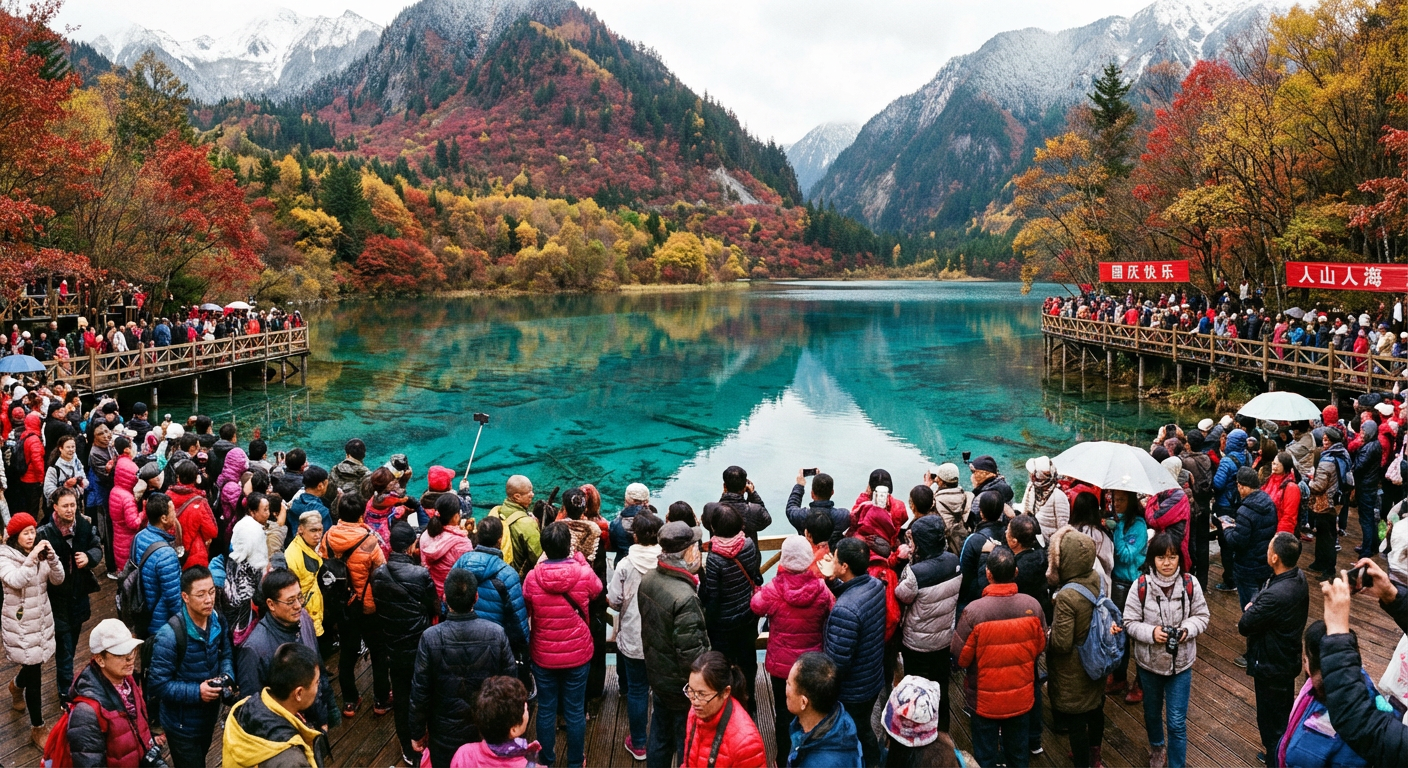
- Color performance: This is the peak scene you see in all the brochures! The entire valley looks as if it has been soaked in an overturned palette. Birch, maple, rowan, and other trees display their fullest golds, fiery reds, and deep crimsons. The crystal-blue lakes form the world’s strongest visual contrast with these brilliant colored forests; reflections intertwine in the water — breathtakingly beautiful.
- Tourist situation: This is the absolute high season of the year, especially October 15–25, when visitor numbers reach their maximum.
- Pros & cons:
- Advantages: Visual impact of the natural landscape reaches the annual peak — the golden period for photography.
- Disadvantages: Crowds surge; the park can be extremely packed; accommodation and transportation are expensive and require booking very early.
- Suitable for: Photographers and nature lovers who pursue the most spectacular autumn colors and don’t mind crowds.
Phase 3: Late Autumn Finale and Winter Prologue (First Week of November)
- Color performance: Leaves begin to fall in large numbers; the forests become more open and serene. Colors shift from bright golds to calmer ochre and bronze tones. The mountain tops are very likely to have received their first snow — you’ll have the chance to capture unique shots of “autumn colors framed with snow-capped mountains.”
- Tourist situation: Visitor numbers drop dramatically; the park regains its tranquility.
- Pros & cons:
- Advantages: Enjoy a quieter, more relaxed Jiuzhaigou; chance to see the unique transition between autumn and winter.
- Disadvantages: Trees are no longer dense; some have already shed leaves; the glorious color intensity is past.
- Suitable for: Travelers who love peace, prefer rugged scenery, and want to experience different seasonal feelings.
My final suggestion:
If your life goal is to witness Jiuzhaigou’s most extreme autumn, then firmly schedule your trip between October 15 and October 25. This is the “golden window” with the lowest risk and highest probability of seeing peak autumn colors.

Chapter 3: Altitude Sickness — Facts and Coping Strategies
Jiuzhaigou Scenic Area ranges in elevation from 2,000 m to 3,100 m (highest point Long Lake at approximately 3,100 m). For the vast majority of healthy adults, this altitude is “moderate-low,” and the probability of severe Acute Mountain Sickness (AMS) is very low.
However, this does not mean you will feel nothing at all. Coming directly from low-altitude areas, your body needs an adaptation period. Common, completely normal mild symptoms include:
- Feeling more short of breath and faster heartbeat than usual when climbing stairs or walking quickly.
- Mild headache or pressure in the head.
- Slight fatigue or dizziness.
These are simply signs that your body is adapting to lower oxygen levels. Do not panic excessively — anxiety itself will worsen discomfort.
A detailed coping guide:
1. Mindset is the first line of defense: Stay relaxed and positive. Tell yourself this is normal and your body will adapt quickly.
2. Consciously slow everything down: Switch your pace to “slow-motion mode.” Stroll leisurely; avoid running or jumping. Be patient when queuing at sightseeing bus stops.
3. Stay well hydrated: On the plateau, the body dehydrates more easily, which worsens altitude symptoms. Always carry a water bottle and keep drinking warm water (many places in the park provide free hot water).
4. Consider portable oxygen: Portable oxygen canisters (around 20–30 RMB) are easily available at park shops or entrance convenience stores. Even if you feel fine, having one on hand provides huge psychological comfort.
5. First-day taboos upon arrival: On the day you arrive in Jiuzhaigou, do not take hot baths, especially not soak in a tub. Hot baths accelerate blood circulation and oxygen consumption, and poor bathroom ventilation can cause discomfort. A simple shower with not-too-hot water is safer.
6. Diet attention: Avoid overeating and binge drinking; try not to drink alcohol, as alcohol exacerbates dehydration and oxygen deficiency.
For the vast majority of tourists coming from Europe, North America, or other continents, Jiuzhaigou’s altitude is completely manageable. Just give your body enough respect and a short adaptation time.
Chapter 4: Which One to Choose When Time Is Limited — In-Depth Honest Comparison with Zhangjiajie, Guilin, and Huangshan
When your China trip is limited and you can only choose one top-tier natural landscape, the decision becomes very difficult. Jiuzhaigou, Zhangjiajie, Guilin, and Huangshan represent four completely different yet equally ultimate aesthetic experiences. Let me give you a deep, honest comparison.
Jiuzhaigou: Fairyland of Water
- Core experience: This is the ultimate ode to “water.” Its beauty is concentrated on the surface and in the lakes — crystal-clear, dazzlingly colorful. The touring style is relatively peaceful, mainly relying on sightseeing buses and boardwalk paths — an immersive, visually overwhelming enjoyment.
- Unique point: Almost nowhere else on earth has such a large-scale, multicolored travertine lake cluster. Combined with strong Tibetan atmosphere, it offers an ethereal and sacred experience.
- Considerations: Located on the western Sichuan plateau with higher altitude; requires slight adaptation. Transportation is slightly farther than the others.
Zhangjiajie: Forest of Stone
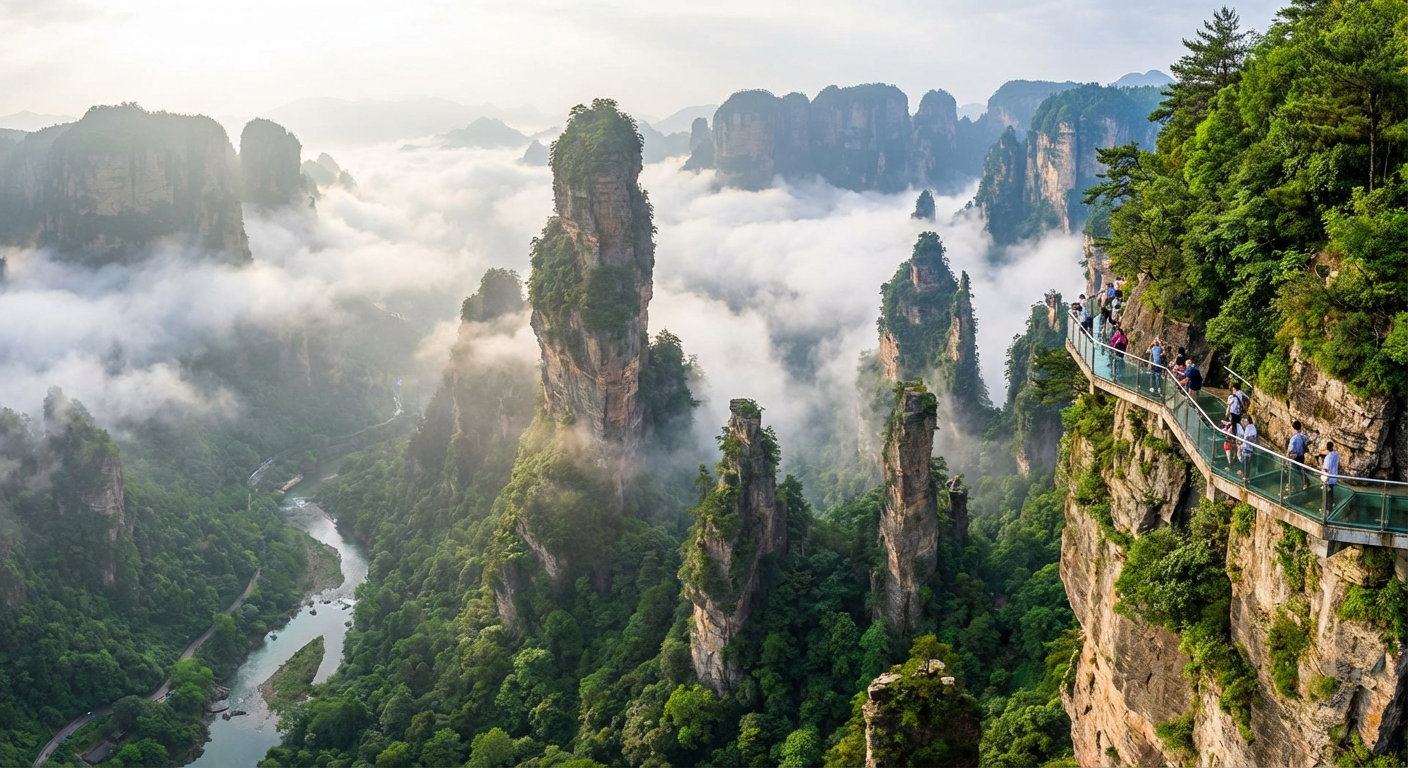
- Core experience: A fantastical adventure about “mountains.” You will witness thousands of quartz sandstone pillars rising straight from the ground, forming a massive “stone forest.” Touring includes thrilling cable cars, glass walkways on cliffs, and long staircases — the experience emphasizes shock and excitement.
- Unique point: Its landform is unique worldwide — the inspiration for the Hallelujah Mountains in the movie Avatar. Its beauty is majestic, bizarre, and full of imagination.
- Considerations: Requires a lot of uphill/downhill walking; high physical demands.
Guilin (Yangshuo): Chinese Landscape Painting
- Core experience: A living scroll of “pastoral poetry.” The karst peaks along both banks of the Li River, together with meandering waterways, rice paddies, and bamboo groves, form a classic Chinese ink painting. Touring is leisurely — bamboo rafting, cycling rural paths.
- Unique point: Its beauty is gentle, elegant, and poetic. It emphasizes the harmonious coexistence of humans and nature in a cultural landscape.
- Considerations: Landscape scale and single-spot visual impact may be slightly less than Jiuzhaigou or Zhangjiajie.
Huangshan: Epic of Mountains
- Core experience: A pilgrimage to the “spirit of Chinese literati.” Famous for its “four wonders”: grotesque pines, bizarre rocks, sea of clouds, and hot springs. Touring Huangshan is a test of body and will, involving massive climbing, but the reward is watching ever-changing scenery above the clouds.
- Unique point: Huangshan is the prototype of Chinese landscape painting, carrying deep cultural heritage. Its beauty is grand, perilous, and full of Zen.
- Considerations: Highest physical demands; weather has huge impact (sunny vs. cloudy/cloud-sea differences are enormous).
Final Decision Guide:
- If you pursue the world’s most unique, most colorful water scenery and want a tranquil yet shocking visual feast, choose Jiuzhaigou.
- If you’re obsessed with bizarre geological landscapes, love thrilling experiences, and have plenty of stamina, choose Zhangjiajie.
- If you long for relaxed, poetic pastoral scenery and want to cycle and raft in the landscape, choose Guilin.
- If you’re a mountaineering enthusiast who wants to challenge yourself and feel China’s deep mountain culture, choose Huangshan.
Jiuzhaigou’s irreplaceability lies in the color of its water — a geographical miracle on Earth.
Chapter 5: The Art of Itinerary — Is One Day Really Enough? How to Plan the Perfect Route?
“Is one day enough?” — a question that needs an honest answer.
Officially only one-day tickets are sold, meaning technically you can cover all major sights in one day by sightseeing bus. However, as an experienced traveler, I must tell you: one day is far from enough. Doing so means you’ll spend most of your time queuing, waiting for buses, and rushing — only “checking in” at beauty spots without truly appreciating, photographing, or feeling them.
My strong suggestion: Plan to stay at least two nights near Jiuzhaigou, giving the park itself a full 1.5 to 2 days. This way you can split the itinerary, explore at a leisurely pace, and be at the most beautiful spots during the best light of the day (early morning and dusk).
Perfect Route Planning (Two-Day In-Depth Tour Plan)
Jiuzhaigou’s three valleys form a “Y” shape. Here is a detailed plan that minimizes repeated routes and optimizes experience.

Day 1: Explore the Two Upper Branches of the Y — Zechawa Valley & Rize Valley Highlights
- Morning (before 8:00): Buy tickets online in advance and enter the park the moment it opens. After entering, you’ll take the sightseeing bus. Key tip: In the morning, buses are dispatched according to crowd flow and usually go directly to one of the top points of the “Y” (typically Long Lake in Zechawa Valley or Primeval Forest in Rize Valley). Follow the arrangement — this ensures you start from the highest point and walk downhill all the way, saving the most energy.
- Morning – Zechawa Valley Journey:
- Get off at Long Lake station. This is Jiuzhaigou’s largest and highest lake — unbelievably majestic in morning sunlight.
- Walk about 15 minutes along the boardwalk from Long Lake to Five-Color Pond. This is the smallest but most colorful pond in Jiuzhaigou; its blue is like concentrated gemstone — must be viewed under direct morning light.
- Take the bus from Five-Color Pond station to Nuorilang Center.
- Noon: Eat and rest at Nuorilang Tourist Center. There are restaurants and shops here.
- Afternoon – Rize Valley Highlights:
- At Nuorilang Center, transfer to the bus heading toward Primeval Forest in Rize Valley.
- Key Stop 1: Five-Flower Lake. This is the pride and soul of Jiuzhaigou. Spend the most time here. Don’t just stay on the main north-shore boardwalk — walk all the way to the south shore and climb to Tiger Mouth (viewpoint on the old highway) to overlook the whole panorama. This is the best spot to shoot the classic blue-green peacock pattern of Five-Flower Lake.
- Key Stop 2: Pearl Shoal & Pearl Shoal Waterfall. Walk from Five-Flower Lake to Pearl Shoal. Here the wide travertine shoal flow splashes countless pearls of water on a milky-yellow surface — hence the name. At the end is the magnificent Pearl Shoal Waterfall, also the filming location for the ending of the 1986 Journey to the West.
- Key Stop 3: Mirror Lake. Go in the afternoon when there is no wind. The lake surface becomes a perfect mirror, reflecting distant snow mountains and colored forests — extremely dreamlike.
- Evening: Take the bus back to the park exit, ending Day 1.
Day 2: Leisurely Tour the Lower Branch of the Y — Shuzheng Valley & Revisit Yesterday’s Highlights
- Morning: Enter the park again. This time leisurely tour the lower branch of the “Y” — Shuzheng Valley.
- Route: Take the bus from the entrance and get off at Rhinoceros Lake. Strongly recommend starting from Rhinoceros Lake and walking all the way downhill along the boardwalk. You will pass Tiger Lake, Shuzheng Waterfall, Shuzheng Group Lakes, and Wolong Lake in sequence. This stretch is one of Jiuzhaigou’s most quintessential experiences, letting you feel up close the terraced connections between lakes and the rushing water.
- Afternoon: You have two options:
1. Revisit classics: Take the bus again to Five-Flower Lake and see how it looks under different light.
2. Explore details: Go to places you didn’t have time for yesterday, such as Arrow Bamboo Lake, Panda Lake, etc.
- Flexible arrangement: If time permits, you can also visit Zharu Valley (Jiuzhaigou’s fourth valley, requires extra reservation) for more primitive hiking and Tibetan culture.
This two-day plan ensures you deeply experience Jiuzhaigou’s essence instead of just brushing past it.
Chapter 6: Avoiding Crowds — How to Shoot Your Own “Empty-Scenery” Masterpieces
Traveling in China, completely avoiding people is unrealistic, but with clever strategies you can absolutely get relatively peaceful experiences and clean photos.
1. Strategic date selection: The most important point. Avoid at all costs China’s National Day Golden Week (October 1–7) and Labor Day holidays (early May). Choose weekdays right after Golden Week or early November — visitor numbers drop significantly.
2. Stay at the gorge entrance: Choose hotels near Jiuzhaigou park gate. This lets you be among the first batch to rush in after opening and the last batch to leave before closing. The first hour after opening and the last 1.5 hours before closing are the quietest and softest-light “golden moments” of the day.
3. Make good use of boardwalks, stay away from bus stops: Tour groups usually cluster around main boardwalks near bus stops. Jiuzhaigou’s boardwalk system is very developed. Walk a few extra steps to the opposite shore, forest paths, or high viewpoints — crowds disappear instantly. For example, at Five-Flower Lake, most people cram the north shore while the south shore boardwalk is much quieter.
4. Secret viewpoints:
- Best panorama of Five-Flower Lake: Tiger Mouth. Located on the old highway, requires walking uphill a bit from Five-Flower Lake station. It takes some effort, but this is the only best spot to overlook the whole Five-Flower Lake and shoot the classic “peacock channel” — far fewer people than lakeside.
- Mirror Lake reflections: Must go in the morning when there is no wind. Once wind starts, reflections disappear.
5. Reverse touring: In the afternoon when most one-day tourists get tired and start leaving, go against the flow to popular spots — far fewer people.
6. Embrace bad weather: Light rain or overcast skies do not diminish Jiuzhaigou’s beauty — they add a hazy mood and scare away many tourists. As long as it’s not heavy rain, this is actually a great chance for unique experiences.
With the above strategies, you will greatly improve your Jiuzhaigou travel quality and leave with beautiful memories undisturbed by others.
Chapter 7: Winter Fairyland — Snowscapes, Blue Ice, and Travel Guide
Many tourists wonder what Jiuzhaigou looks like in winter. The answer: it transforms from a colorful palette into a tranquil, sacred ice-and-snow kingdom. Winter (late November to March) Jiuzhaigou is a secret season for many photographers and tranquility seekers.
Does Jiuzhaigou close in winter?
No! Jiuzhaigou is open year-round. Winter is the official off-season; visitor numbers plummet — you can enjoy the quietest experience of the year.
Unique charm of winter landscapes:
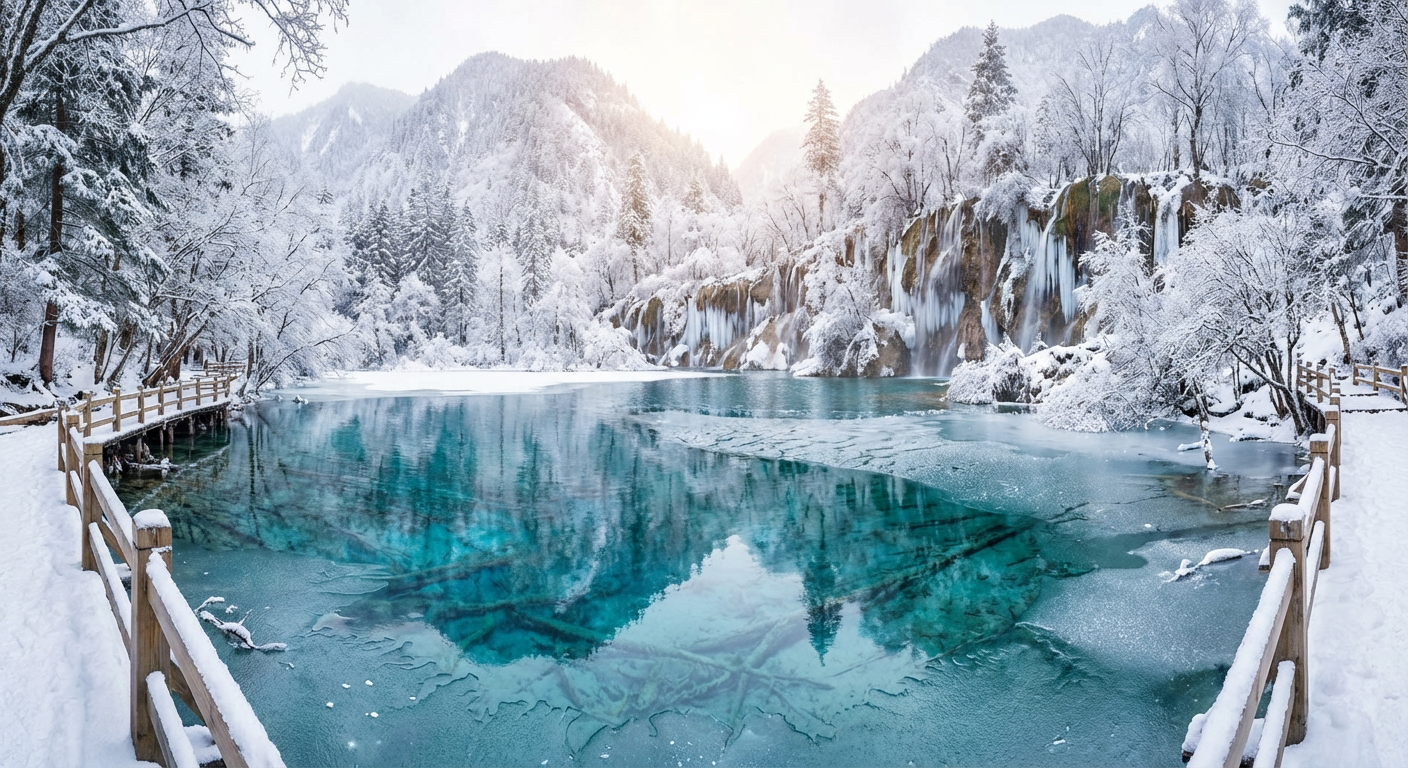
1. Blue Ice Wonder: As temperatures drop below zero, parts of waterfalls and slower-flowing lake edges start freezing. Nuorilang Waterfall, Pearl Shoal Waterfall, etc., form huge ice cascades as if time were frozen. Most magically, because Jiuzhaigou’s water is extremely pure, the ice is not white but a deep, pure blue ice — contrasting beautifully with unfrozen blue-green water, extremely dreamlike.
2. Snow-Covered Colored Forests: Autumn’s multicolored forests are blanketed in pure white snow; black-and-white trunks with blue-white ice lakes form a classic ink painting. Every branch is wrapped in pristine rime — the whole world feels extraordinarily serene and ethereal.
3. Rarely Trodden Tranquility: Winter’s greatest gift. You can have entire lakes to yourself, listening to the crunch of snow underfoot and the dripping of melting ice waterfalls — a luxury unimaginable in peak season.
Winter travel challenges & preparation:
- Weather & road conditions: Very cold, usually –5°C to –10°C. Some boardwalks may be temporarily closed due to snow or ice for safety. Must wear non-slip snow boots.
- Clothing advice: Use the layering method — moisture-wicking base layer, insulating fleece or down mid-layer, windproof/waterproof outer shell or thick down jacket. Hat, scarf, gloves, thick socks essential.
- Services: Some restaurants and shops inside the park may reduce hours; bring more high-calorie food and hot water.
Chapter 8: Cultural Exploration — Tibetan Atmosphere Beyond the Scenery
Jiuzhaigou gets its name from the nine ancient Tibetan villages inside the valleys. So can tourists experience real Tibetan culture here, or only commercialized performances?
Answer: Both exist — it depends on how you explore.
Villages inside the park:
- Examples: Shuzheng Village, Zechawa Village. These have prime locations and are part of the tour route.
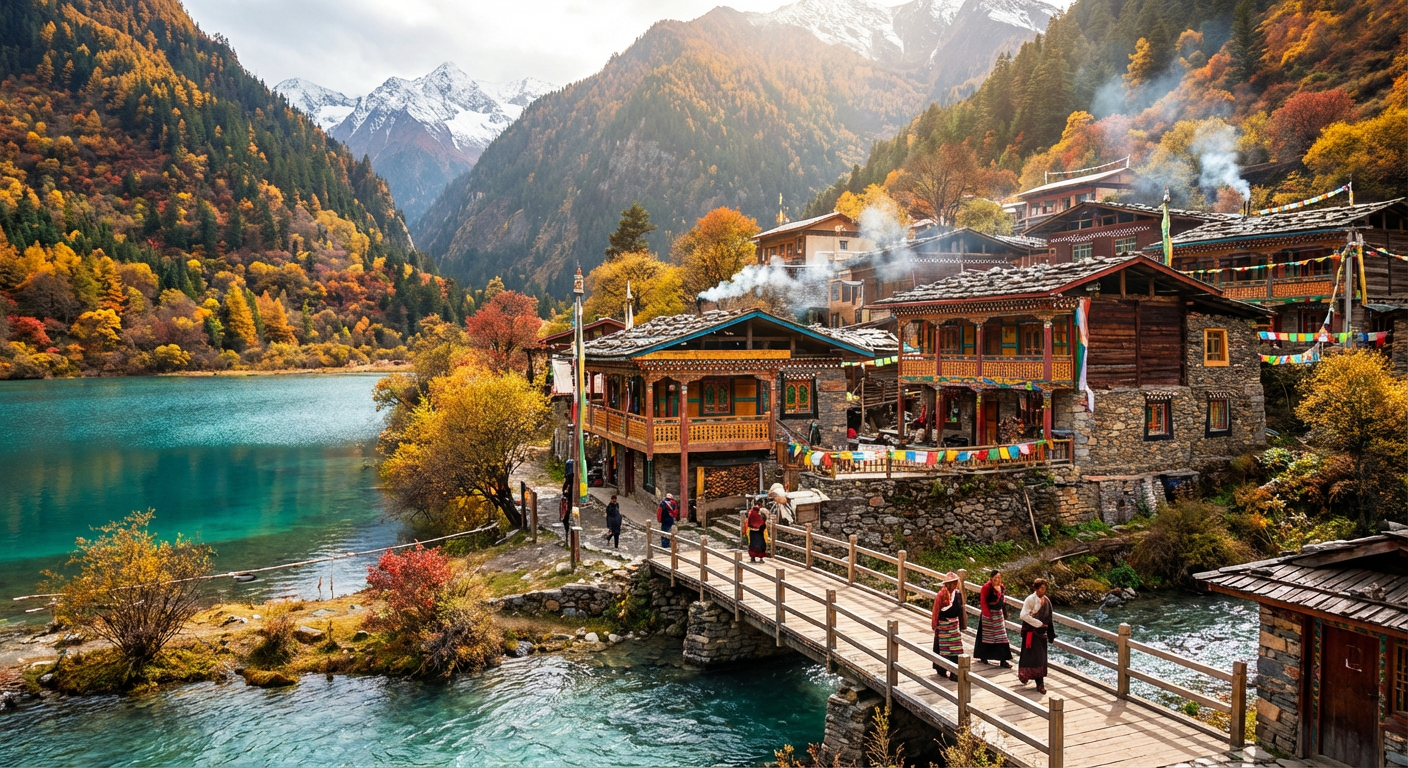
- Current status: Highly tourist-oriented; main functions are selling souvenirs, Tibetan costume photos, and simple dining. You can see traditional Tibetan stone-block houses, but most original residents have moved out — daily-life atmosphere is thin.
- Experience: Quick look at architecture, buy some crafts, but don’t expect deep cultural interaction.
Finding more authentic Tibetan experience:
If you’re interested in deeper culture, look outside the main park:
1. Zhongcha Valley: About 20 minutes by car from Jiuzhaigou, known as “Jiuzhaigou’s back garden.” Not yet heavily developed, with several quiet Tibetan villages. You can book local Tibetan homestays, eat host-made Tibetan hotpot, butter tea, and highland barley wine, dance pot-zhuang around the bonfire in the evening, and listen to their local stories. This is true immersive experience.
2. Ganhaizi Scenic Area and surroundings: On the way to Jiuzhaigou, you’ll pass Ganhaizi (also called “Love Sea”) with similar Tibetan homestay options nearby.
3. Watch the show “Jiuzhaigou Eternal Romance”: If you’re interested in Tibetan history, legends, and dance, this large-scale stage performance at the gorge entrance is a great choice. Using modern lighting and effects, it condenses Tibetan-Qiang culture, myths, and history into one high-quality show. Though commercial, its artistry and viewing value are very high, helping you quickly understand local culture vividly.
Cultural experience summary: In Jiuzhaigou, the magnificent natural scenery is the absolute protagonist, but if you’re willing to spend a little more time and effort stepping outside the main park, real, vibrant Tibetan culture is waiting in the nearby valleys.
Chapter 9: Must-Know Before You Go
Tickets & Sightseeing Bus
- Prices:
- Peak season (April 1 – November 15): Ticket 169 RMB/person + sightseeing bus 90 RMB/person = 259 RMB/person.
- Off-season (November 16 – March 31 next year): Ticket 80 RMB/person + sightseeing bus 80 RMB/person = 160 RMB/person.
- Booking method 【extremely important】: Since 2024, Jiuzhaigou strictly enforces advance real-name reservation ticketing. No on-site ticket windows, no same-day tickets available.
- How to book: Must book in advance through official online platforms. Most reliable channels:
- Aba Tourism Net official website.
- Official WeChat public accounts: “Aba Tourism Net” or “Jiuzhaigou”.
- How far in advance: Tickets are usually released 7 days in advance. During National Day peak, they can sell out in minutes — plan and grab early.
- Required info: Must accurately fill in each visitor’s passport name and passport number; entry requires person-ID-ticket match and gate verification.
Transportation: Three Ways from Chengdu to Jiuzhaigou
1. Flight:
- Route: Fly from Chengdu Shuangliu or Tianfu International Airport to Jiuzhaigou-Huanglong Airport (JZH), flight time about 1 hour. Then airport bus or private car to Jiuzhaigou (~1.5–2 hours).
- Advantages: Fastest, most time-saving.
- Disadvantages: Most expensive; flights easily delayed/canceled due to weather; airport altitude is high (3,448 m) — may increase altitude sickness risk.
2. Self-drive / Private car:
- Route: Currently mainly the “Jiuzhai Ring Road West Line” — from Chengdu via Dujiangyan, Wenchuan, Mao County, Songpan to Jiuzhaigou, total ~400 km.
- Road conditions: Now mostly excellent highways and paved roads with many tunnels — past risks greatly reduced. Driving time ~7–9 hours.
- Advantages: Highest freedom; stop anytime to enjoy scenery along the way (e.g., Minjiang Valley).
- Disadvantages: Still some mountain roads; driver needs good mountain-driving experience; fatigue driving is main risk.
- Private car cost: Depending on vehicle and season, about 1,500–2,500 RMB/day (including driver, fuel, tolls) — comfortable and worry-free middle option.

3. Scenic area direct bus:
- Route: From Chengdu Xinnanmen or Chadianzi bus stations, direct buses to Jiuzhaigou entrance visitor center.
- Advantages: Best value, safe and reliable, no need to worry.
- Disadvantages: Fixed schedule, low freedom, longer ride (~8–10 hours).
My suggestion: For most international tourists, private car or direct scenic bus is wiser and more relaxed than self-driving.
Food & Gear Inside the Park
- Park dining: Nuorilang Service Center is the only large restaurant, offering buffet at 60 RMB, 98 RMB, etc. Also instant noodles, grilled sausage, corn, etc.
- My suggestion: Bringing your own food is the best experience. Recommended: self-heating rice/hotpot, energy bars, chocolate, bread, fruit, etc. This way you can enjoy a picnic beside any beautiful lake instead of squeezing into restaurants at mealtimes.
- Must-have gear list:
- Documents: Passport (for verification), cash (some small vendors can’t use international cards).
- Clothing: Prepare according to season, but a windproof jacket is necessary anytime. Comfortable hiking shoes are crucial.
- Sun protection: Plateau UV is strong — sunscreen, sunglasses, wide-brim hat essential.
- Electronics: Camera, power bank. China-standard plug adapter.
- Others: Moisturizing skincare, portable oxygen canister (backup), personal medication.
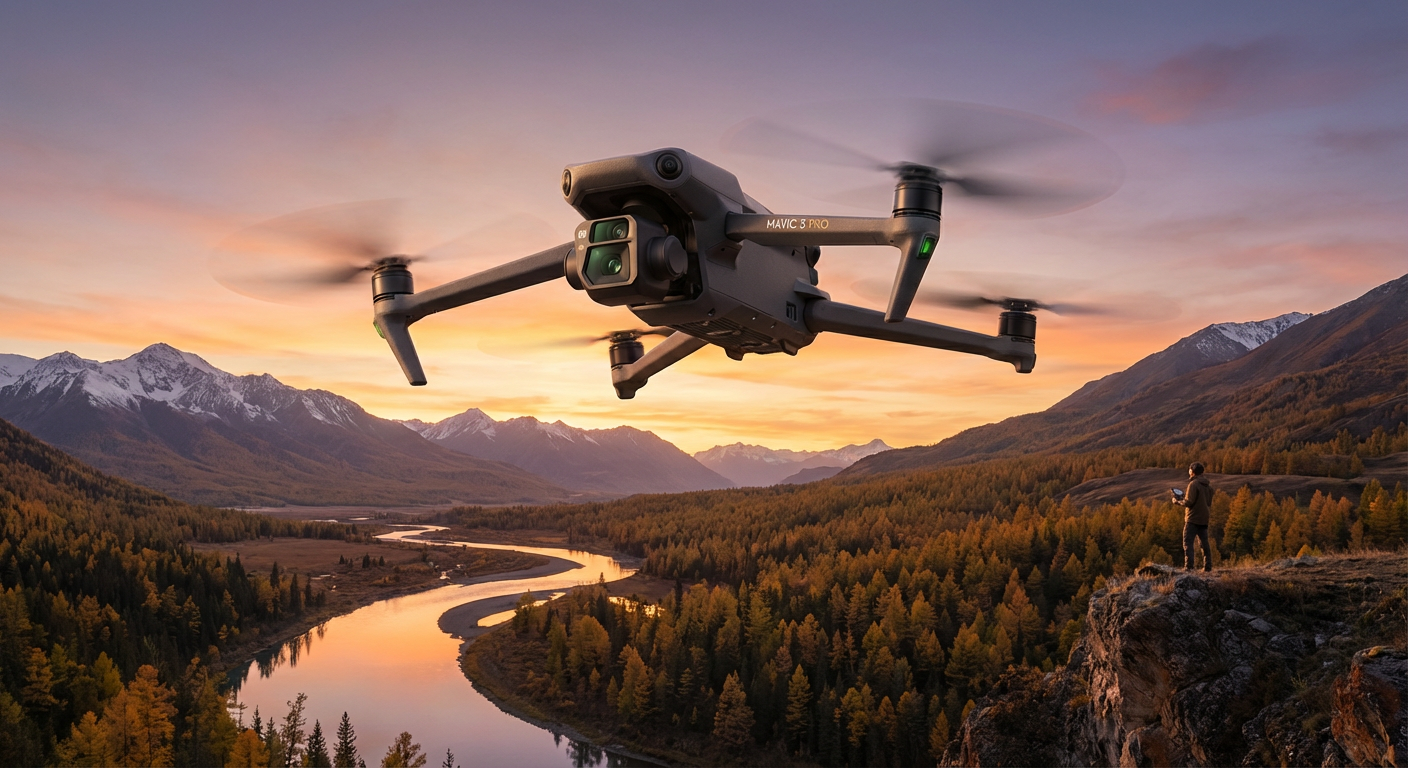
Drone Policy
- Clear regulation: According to Jiuzhaigou National Park management rules, flying drones without permission is strictly prohibited throughout the entire scenic area.
- Reason: To protect visitor safety, wildlife, and everyone’s viewing experience. Drone noise breaks the natural tranquility.
- Serious reminder: Strictly comply. The park has surveillance and staff — once discovered, you will be stopped firmly, equipment may be temporarily confiscated, and you will face fines. Do not take chances.
Conclusion: Begin Your Jiuzhaigou Dreamlike Journey
Jiuzhaigou, this place listed as a UNESCO World Natural Heritage site, is not just a tourist destination — it is more like a pure faith in the beauty of nature. It teaches us that the Earth truly possesses such extreme colors and harmony.
I hope this detailed Jiuzhaigou guide can dispel all your doubts and pave every road to this fairyland for you. From revealing the scientific principles of the lake colors to helping you precisely lock the peak autumn moment; from planning the perfect tour route to taking you to find the most authentic Tibetan atmosphere — all this information aims to make your Jiuzhaigou trip a truly regret-free perfect experience of a lifetime.
Now, you are ready. Take this guide, bring a heart full of awe, and set off. Jiuzhaigou’s mountains and waters are quietly awaiting your arrival.
Comments (0)
CC BY-NC-ND 4.0 License
Credit to Gerry Hu / ChinaTravelPDF
No commercial use
No modifications allowed
Unlock Remaining 70% Premium Content
This is a VIP Exclusive Article. Become a lifetime member to unlock all VIP articles and all available city guides.
🎁 1 Year Free Expert Q&A Support (Early Bird Exclusive - First 500 Only)
China National Highway 318
20 Must-Visit Attractions You'll Regret Missing (FREE PDF)
